


After the lotion paint film is formed, the polymer in the particles still presents a free single molecular shape, and there is a lack of strong chemical bond between the molecules, which results in the low-temperature embrittlement of the paint film and the high-temperature backtack. The fusion between lotion particles in the film forming process is far from uniform. Water will diffuse and penetrate through the hydrophilic particle interface, and the coating will swell or even dissolve, showing poor water resistance. These shortcomings can be improved through self crosslinking technology. The self crosslinking reaction of lotion can occur at room temperature with the evaporation of water and the decrease of pH value. When the temperature is raised to 50-60 ℃, the self crosslinking reaction can proceed rapidly. Because this cross-linking reaction takes place in the late stage of film formation, it has little impact on the penetration between lotion particles. The tolerance of lotion polymer molecular weight and glass transition temperature is greater, and good film formation effect can be achieved without greatly increasing the amount of film forming additives.
Ketocarbonyl and hydrazide can undergo rapid chemical reactions at room temperature:

The practical carbonyl compound is diacetone acrylamide (DAAM):
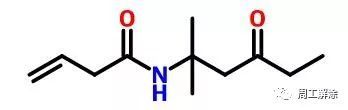
The compound has double bonds in the molecule, which can participate in the polymerization of vinyl monomer and combine into the lotion polymer molecule, providing the necessary cross-linking reaction functional group for the polymer molecule. DAAM can easily copolymerize with various monomers and can also be homopolymerized. The reactivity ratios of methyl methacrylate and DAAM copolymerization are γ 1=1.68 and γ 2=0.57; The reactivity ratio of styrene and DAAM copolymer is 1.77 and 0.49, respectively. The physical properties of product DAAM are shown in Table 1.
Table 1. Physical Properties of Diacetone Acrylamide (DAAM) and Adipic Acid Dihydrazide (ADH)
| Performance | DAAM | ADH |
| Molecular formula | C9H15NO2 | C6H14N4O2 |
| Molecular weight | 169.2 | 174.2 |
| Relative density | 0.998(60℃) | |
| Viscosity/mPa · s | 17.9(60℃) | |
| Melting point/℃ | 54-56 | 177~183 |
| Boiling point/℃ | 120(8mmHg) | |
| Solubility in water/(g/100g水) | >100 | 12.54(30℃) |
| LD50(mg/kg) | 1770 | 5000 |
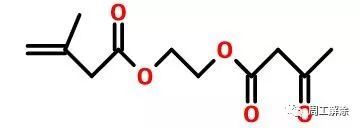
Acetylacetoxyethyl methacrylate (AAEM) can also participate in the free radical polymerization of acrylic esters as a provider of ketone carbonyl groups. AAEM has low toxicity and is highly prone to participate in copolymerization reactions. In addition, its acetyl group can also undergo crosslinking reactions with polyamine compounds. Adding amine or ammonia water to the copolymer can increase the pH value of the system to above 9, and the acetyl group can be converted into stable enamine, thereby improving the storage stability of the system. After the water evaporates and the pH value changes, room temperature crosslinking reaction occurs, and the product obtains good solvent resistance, water resistance, and anti adhesion properties. Acetylacetyl groups can also undergo Michael addition reactions with unsaturated groups and form self crosslinking systems. The structural formula of acetylacetoxyethyl methacrylate (AAEM) is as follows:
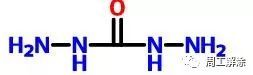
Representative hydrazide crosslinking agents include:
carbohydrazide
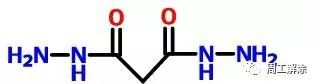
Malonic acid hydrazide
Succinic acid hydrazide
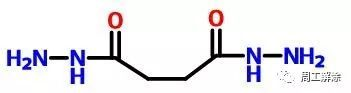
Dihydrazide glutarate
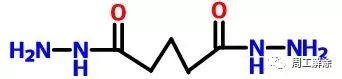
Adipic acid hydrazide (ADH)
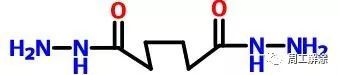
Adipate dihydrazide (ADH) is the most suitable hydrazide crosslinking agent. Its physical properties are shown in Table 1. The combination of ADH and diacetone acrylamide has been widely used in waterborne paint lotion. ADH is weakly alkaline. If solid ADH is directly added to lotion, coalescence may occur. Generally, ADH should be dissolved in hot water (poor solubility in cold water) and reused.
Polymers containing hydrazine can also be used for crosslinking.
In the self crosslinking lotion, DAAM is in the lotion particles, while ADH is in the water phase. Due to their different phase regions, they cannot come into contact and react in the presence of water. After the water evaporates, ADH gradually enters the polymer, and cross-linking reaction occurs immediately. However, the two reactive functional groups in lotion will inevitably contact more or less at the lotion particle interface, which will gradually increase the minimum film forming temperature (MFFT) of lotion after storage. Acid can significantly accelerate the reaction between ADH and DAAM. The acrylic acid used in the preparation of lotion should be controlled below 0.5% of the total amount of monomers to avoid affecting the stability of self crosslinking lotion. For the same reason, the final lotion product should be adjusted to weak alkaline with ammonia or organic amine. With the volatilization of ammonia in the film forming process, the pH value of the system gradually decreases, which is conducive to accelerating the self crosslinking reaction.
DAAM is directly added to the monomer to participate in polymerization. In order to ensure the performance and storage stability of the lotion, the amount of DAAM generally does not exceed 8% of the lotion, preferably about 5% (Table 2). The amount of DMMA is small, and the cross-linking modification effect is poor. If the amount of DMMA is too large, the particles of the lotion will become thicker, the blue light will weaken or even disappear, the amount of gel will increase during synthesis, and the stability of the lotion will be poor.
DAAM and ADH should be used equivalently, that is, the amount ratio of ADH/DAAM is about 1.03/1, the amount of ADH is small, and the cross-linking is incomplete, and all aspects will decline (Table 3). Generally, ADH is added after the completion of lotion synthesis reaction when the temperature drops below 50 ℃.
Table 2. Effect of DAAM dosage on acrylate lotion
| DAAMdosage,% | lotion appearance | viscosity | agglomerate content,% |
| 0 | white, blue | 30.4 | 0.06 |
| 3 | white, blue | 34.6 | 0.15 |
| 5 | white, blue | 33.2 | 0.62 |
| 8 | white, blue | 38.6 | 1.47 |
| 10 | white, blue | 40.7 | 1.98 |
| 12 | blue-green light | 94.3 | 2.76 |
| 16 | White | 163.7 | 3.28 |
Table 3. Effect of carbonyl/hydrazide equivalent ratio on the performance of acrylate lotion
| Equivalent ratio | 2/1 | 2/1.5 | 1/1 |
| Appearance of lotion | Transparent | Transparent | Transparent |
| Water absorption rate/% | 80.5 | 67.7 | 42.3 |
| Swelling rate in toluene/% | 124.7 | 80.2 | 53.7 |
| Tensile strength/MPa | 3.9 | 5.1 | 6.2 |
| Fracture elongation/% | 800 | 675 | 590 |
The presence or absence of self crosslinking has a significant impact on the performance of paint. The tensile strength of paint films without self crosslinking changes significantly with temperature compared to products with self crosslinking. There is a more significant difference in elongation at break, and the self crosslinking paint film shows almost no significant change within the range of -20~40 ℃
The phenomenon of cold brittleness and hot adhesion of paint film without self crosslinking is obvious. The storage test showed that the mechanical properties and MFFT of the self crosslinking paint film did not change after 6 months. The water resistance test also showed significant differences. The paint film without self crosslinking turned white, swollen, and had severe foaming after immersion in water, while the single component self crosslinking paint film greatly improved its water resistance.
Self crosslinking technology is not only used in the synthesis of acrylic lotion, but also widely used in the preparation of acrylic polyurethane hybrid and core-shell lotion.
Example of synthesis of lotion varieties with room temperature self crosslinking technology:
1. Self crosslinking styrene acrylic lotion
① Formula
| Component raw | materials | kg |
| A Base material | K12 | 0.34 |
| OP10 | 0.68 | |
| NaHCO3 | 0.079 | |
| H2O | 65 | |
| B monomer | MMA | 26 |
| ST | 13 | |
| BA | 22.5 | |
| DAAM | 1.34 | |
| A172 | 1.6 | |
| C monomer | NMA | 0.975 |
| AA | 1 | |
| H2O | 8 | |
| D initiator | KPS | 0.27 |
| 水 | 9 | |
| E Eliminate | SFS | 0.074 |
| 水 | 2 | |
| TBH | 0.093 | |
| 水 | 2 | |
| F crosslinking monomer | ADH | 0.67 |
| 水 | 5 |
Note: 1 This formula is styrene acrylic lotion, the glass transition temperature is designed to be 30 ℃, and the monomer is directly dropped into the feed.
2. Emulsifier accounts for 1.5% of the total monomer amount, and initiator accounts for 0.40% of the total monomer amount.
3. ADH is half of DAAM.
② Synthesis process
Bottom material is dispersed and heated to 85 ℃; Monomer B, monomer C, and initiator were added dropwise in three parts simultaneously. The dropwise addition was completed within 3 hours and incubated for 1 hour. The mixture was cooled to 65 ℃ and then eliminated, and incubated for 0.5 hours. After cooling to 40 ℃, the pH was adjusted to 8; Add ADH, stir for 20 minutes, and discharge.
Solid content: 41.95%; pH=8。
2. Self crosslinking pure acrylic lotion for wood paint
① Formula
| Component raw | materials | g |
| A Bottom material | water | 30 |
| Sodium bicarbonate | 0.1 | |
| Sodium dodecyl benzene sulfonate | 1.2 | |
| B monomer pre lotion | water | 15 |
| Sodium dodecyl benzene sulfonate | 1.8 | |
| MMA | 24.8 | |
| BA | 13.64 | |
| MAA | 0.65 | |
| DAAM | 0.92 | |
| C initiator | water | 15 |
| SPS | 0.16 | |
| D Neutralizer | ammonia water 28% | appropriate amount |
② Synthesis process
Feed the bottom material into the reactor and raise the temperature to 85 ℃; Add 20% monomer pre lotion for 15min heat preservation; Add 30% initiator solution, and at the same time, drip the remaining monomer lotion and initiator solution. After about 3h of dripping, keep the temperature for 1h; cool down to 40 ℃, add 0.4gADH (adipate dihydrazide), stir for 0.5h to reduce to room temperature, adjust the pH value, filter and discharge with 100 mesh nylon screen.
Theoretical solid content 40%, Tg 30 ℃, viscosity 60mPa · s
Post time: Aug-28-2026