


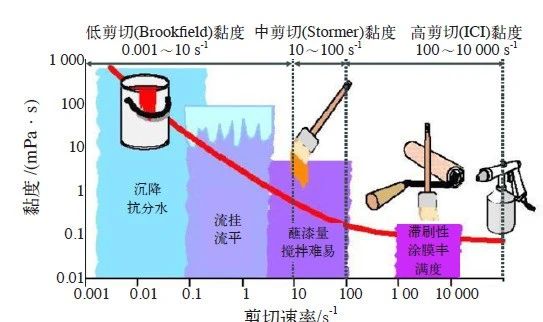
Compared to solvent based coatings, water-based coatings have a more complex formulation system. In formula design, it is not only necessary to pay attention to the type and performance of water-based resins, but also to select various functional additives reasonably and pay attention to their mutual influence. Rheological additives are key components in coating formulations, and the rheological properties of water-based coatings are a complex relationship between viscosity and shear force, as shown in Figure 1, which determines the production, storage, and application performance of coatings.
Figure 1 Relationship between Coating Production Application and Rheological Properties
The commonly used rheological agents in water-based coatings can be divided into two categories based on their chemical properties: organic and inorganic.
1. Inorganic rheological additives
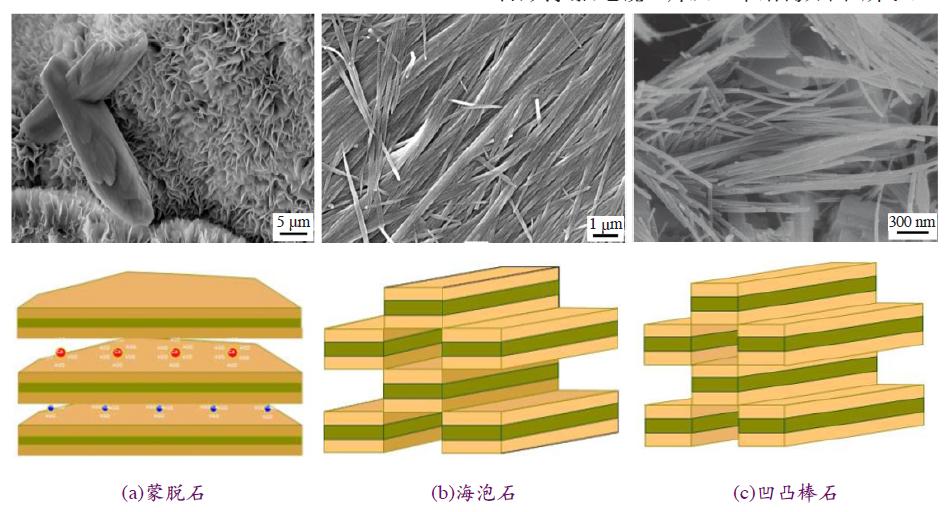
In the coatings industry, a special type of clay mainly composed of silicates is commonly used as an inorganic rheological modifier. These substances are mostly supplied in powder form and can be well dispersed in coatings, serving as suspending agents or gelling agents. Inorganic rheological modifiers often have high yield values and thixotropic characteristics, which are used to improve the anti sagging, anti settling, anti dehydration shrinkage, and anti splash properties of coatings. The common rheological modifiers for clay mainly include montmorillonite, sepiolite, and attapulgite. Their scanning electron microscopy images and basic structures are shown in Figure
1.1 Montmorillonite
Montmorillonite is a layered mineral composed of extremely fine particles of hydrated aluminosilicates, as shown in Figure 2 (a), with aluminum oxide octahedra in the middle and silicon oxide tetrahedra above and below, forming a three-layer sheet-like structure. Bentonite is a typical clay mineral mainly composed of montmorillonite. The interlayer of montmorillonite crystals contains water and cations, which have a high ion exchange capacity and therefore strong water absorption and expansion ability.
In aqueous media, the interlayer cations of montmorillonite undergo solvation and expand, causing the particles to separate. At the same time, as the silicon oxygen and aluminum oxygen bonds break, their edges and surfaces become charged, and different electrostatic associations occur between the surface and edges, forming a “card house” – shaped interpenetrating network structure. This unique three-dimensional structure can encapsulate water and fillers, resulting in thickening and good storage stability of the system.
When the system is subjected to strong shear forces, the network structure dissociates and exhibits significant shear thinning properties, giving the coating good leveling properties. Once the shear force disappears, the network structure is restored under the action of hydrogen bonds, providing good anti sagging performance.
In the static storage state of the coating, the columnar particles of this type of bentonite are dispersed between the sheet-like particles, playing a supporting role. When subjected to shear force, hydrogen bonds are broken and columnar particles are oriented in the direction of flow. After the shear force disappears, these columnar particles can quickly rearrange. Therefore, the introduction of this new type of bentonite makes the coating have better storage stability and thixotropy.
1.2 Sepiolite
Sepiolite is a fibrous magnesium silicate clay mineral with a large specific surface area and unique pore structure. As shown in Figure 2 (b), in terms of microstructure, the particles of sepiolite exhibit an equiaxed needle bundle shape. The structural unit of sepiolite contains continuous layers of silicon oxygen tetrahedra, each of which shares three vertices and is connected to adjacent three tetrahedra, forming open channels of fixed size parallel to the chain.
In aqueous systems, sepiolite particles dissolve to form an irregular fibrous network structure, which contains water and forms a high viscosity suspension, resulting in thickening of the system. When subjected to shear force, the network structure dissociates and viscosity decreases. Once the shearing effect disappears, the network structure is restored and the viscosity increases. This rheological property is influenced by concentration, shear rate, and pH value. Due to its large pore structure, sepiolite can accommodate more water molecules, resulting in very high thixotropy. It has ideal anti settling and anti sagging effects for coating applications.
The application of sepiolite as a rheological thickener in water-based architectural coatings shows that the introduction of sepiolite can not only effectively regulate the viscosity and leveling of the coating, but also improve the contrast ratio and scrub resistance to a certain extent.
1.3 Concave convex bar stone
Attapulgite is a crystalline hydrated magnesium aluminum silicate mineral, as shown in Figure 2 (c), with unique nano rod like structural characteristics. In crystallography, both attapulgite and sepiolite crystals belong to the monoclinic crystal system, but the pore widths between the unit layers are different. After dispersion in an aqueous medium, the crystal of attapulgite undergoes chemical bond breakage and hydration reaction, resulting in a small amount of surface charge.
After dissociation, the rod-shaped crystals are entangled with each other through a series of forces such as electrostatic force, van der Waals force, and water force, and overlap with each other to form a disordered three-dimensional network structure, which restricts the flow of water. Moreover, due to the small diameter of the rod like crystal, it has a strong adsorption capacity, which can absorb lotion particles and pigment and filler particles on the edge or end of the rod like crystal to form a moderate spatial network. Various particles are filled in the gaps of the attapulgite crystal, which increases the viscosity of the system and plays a thickening role.
Research has found that the smaller the particle size of attapulgite, the shorter its crystal clusters, and the weaker its ability to cross entangle, resulting in a weaker network structure and lower rheological properties. In addition, due to the low surface charge of attapulgite, it is not significantly affected by electrolyte and pH values. Research has found that the synergistic effect of attapulgite, bentonite, and silica can effectively improve the anti sagging performance of water-based epoxy zinc rich primer (partially recommended for use in inorganic coatings).
2 Organic rheological additives
Fig. 3 Comparison of action modes of non associated and associated rheological additives (yellow represents lotion particles)
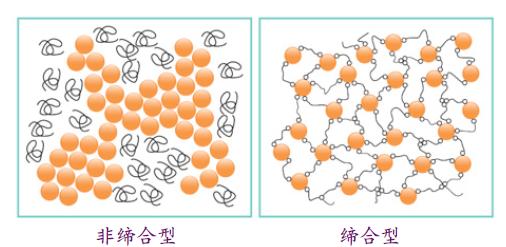
Organic rheological agents can be classified into non associative and associative types according to their mode of action. As shown in Figure 3, non associative rheological agents mainly occupy a certain space in the system by absorbing water and expanding, causing entanglement of polymer chains, and exerting thickening effects through volume repulsion. Association type rheological additives form a three-dimensional network structure through the association of their own hydrophobic groups and the association with latex particles, and restrict the free flow of latex particles to achieve thickening effect.
2.1 Non associative rheological additives
2.1.1 Hydroxyethyl cellulose (HEC)
Figure 4 Schematic diagram of cellulose molecular structure
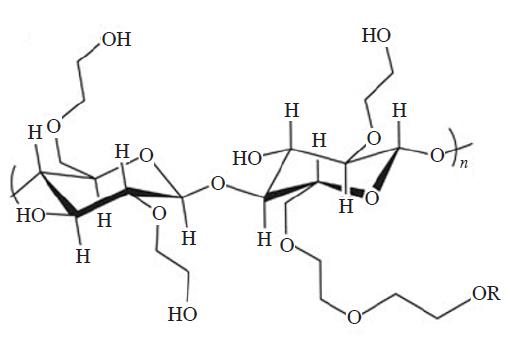
Hydroxyethyl cellulose (HEC) is a non-ionic soluble cellulose ether obtained by etherification reaction of alkaline cellulose and ethylene oxide. Its chemical structure is shown in Figure 4, where the R group is a hydrogen atom. In aqueous solution, the hydrophobic main chain of HEC molecules hydrates with surrounding water molecules through hydrogen bonding, absorbing a large amount of water and causing volume expansion. Meanwhile, due to the high molecular weight of HEC, molecular chains intertwine, resulting in an increase in the viscosity of the system.
At present, HEC is widely used as a thickener in water-based architectural coatings, and its thickening efficiency mainly depends on its molecular weight and the hydration ability of polar groups. At low shear rates, cellulose molecular chains are in a disordered winding state, resulting in the system exhibiting high viscosity. At high shear rates, the ordered arrangement of molecules reduces the viscosity of the system. HEC has high thickening efficiency, a wide range of applicable pH values, and good anti sagging performance. But at the same time, there are also many defects, such as poor leveling and easy splashing.
In addition, as HEC is a natural polymer, the C-O-C glycosidic bonds between polysaccharides are susceptible to fungal erosion and hydrolysis, causing chain breakage and loss of function. Usually, a certain amount of fungicide is added to the formula of water-based latex paint to prevent spoilage, but once cellulase enzymes are produced, the fungicide’s effect on them is not significant.
2.1.2 Alkali swelling acrylic lotion (ASE)
Figure 5 Protonation Process of Alkali Swelling Thickener
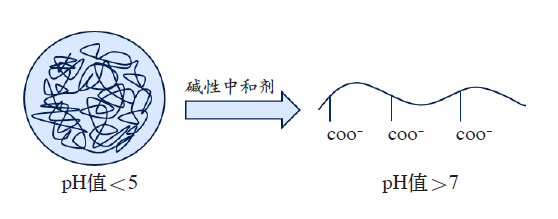
Alkali swelling acrylic lotion (ASE) is an aqueous dispersion of acrylic copolymer, which is usually copolymerized by methacrylic acid and ethyl acrylate. As shown in Figure 5, under acidic conditions, ASE exhibits a tightly coiled and curled shape. After adding an alkaline neutralizing agent, the acidic groups in ASE molecules dissociate, and the carboxyl groups expand the polymer chains under electrostatic repulsion. As the pH value further increases, more free long-chain structures are generated, causing entanglement and increasing the viscosity of the system. ASE thickeners mainly improve medium and low shear viscosity, with high yield values and thixotropy.
ASE has good compatibility with various lotion systems, and is not easy to be degraded by biological enzymes. However, during use, there may be incomplete stretching of the initial chain and subsequent thickening, resulting in unstable viscosity of the system. Therefore, it is crucial to add an appropriate amount of alkaline neutralizing agent to maintain the pH value of the system at 8-10, and to track the changes in pH value and viscosity of the test coating after a period of room temperature storage and hot storage.
2.2 Combination type rheological additives
2.2.1 Hydrophobic modified hydroxyethyl cellulose (HMHEC)
By reacting hydrophobic modification reagents with the side chains of HEC, associative hydrophobic modified hydroxyethyl cellulose (HMHEC) can be obtained. The chemical structure of HMHEC is shown in Figure 4, but the R group at this time is a hydrophobic alkyl chain. HMHEC can achieve aqueous phase thickening through hydrogen bonding and molecular chain entanglement like traditional HEC. In addition, it can also thicken coatings through self association of side chain hydrophobic groups and association with other components of coatings, such as lotion particles.
Figure 6 Rheological curves of HMHEC and HEC aqueous solutions
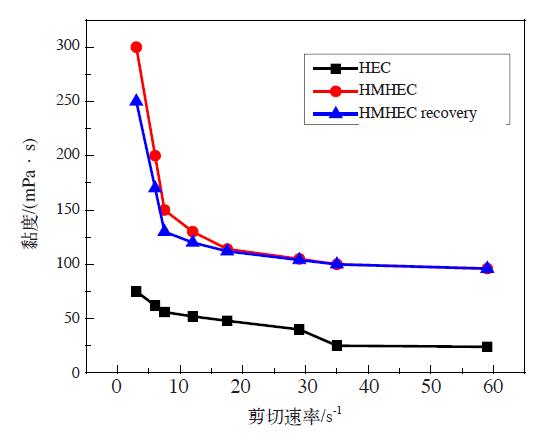
The rheological curves of HEC and HMHEC aqueous solutions are shown in Figure 6. From Figure 6, it can be seen that both HEC and HMHEC exhibit shear thinning characteristics. Differently, at rest or low shear rates, the dual thickening effect of HMHEC results in high viscosity, while as the shear rate increases, the relatively weak hydrophobic binding network structure is disrupted, leading to a rapid decrease in viscosity, which then stabilizes like HEC.
In addition, when the shear rate decreases, HMHEC molecules form a molecular network structure again, leading to an increase in viscosity, but with a certain degree of hysteresis. This is because the reversible equilibrium of network structure association and dissociation has a certain time dependence, manifested as a thixotropic fluid characteristic. Compared with HEC, HMHEC can provide better rheology and splash resistance for water-based coatings.
2.2.2 Hydrophobically modified alkali swelling acrylic lotion (HASE)
Hydrophobically modified alkali swelling acrylic lotion (HASE) is a kind of anionic thickener, which introduces hydrophobic acrylate monomer into the chemical structure of ASE.
HASE basically retains the characteristics of ASE, such as pH dependence, easy dispersion, and resistance to microbial degradation. At the same time, due to the introduction of hydrophobic structures, HASE can thicken the system through the entanglement of polymer chains under alkaline conditions. Moreover, long-chain hydrophobic groups aggregate together in the aqueous phase to form a micelle structure and undergo intramolecular binding. It can also form a three-dimensional network structure through binding with latex particles, pigment particles, and surfactants, resulting in higher thickening efficiency and better thixotropy.
In water-based coating formulations, HASE is sensitive to the use of dispersants and often competes with hydrophobic polyacid copolymer dispersants for adsorption, leading to flocculation of pigments and fillers. Therefore, HASE is more suitable for use in combination with polymeric acid homopolymers and hydrophilic polymeric acid copolymer dispersants.
In addition, both ASE and HASE need to be pre diluted or pre neutralized during use to avoid gel or flocculation when their strong acidity is mixed with water-based formula system. In addition, alkali swelling thickeners are also sensitive to electrolytes and have poor water and alkali resistance.
2.2.3 Hydrophobic Modified Ethylene Oxide Polyurethane (HEUR)
Hydrophobic modified ethylene oxide polyurethane (HEUR) is a water-soluble polymer of hydrophobic modified ethoxy polyurethane, belonging to non-ionic associative thickeners.
Figure 7 Schematic diagram of HEUR molecular structure
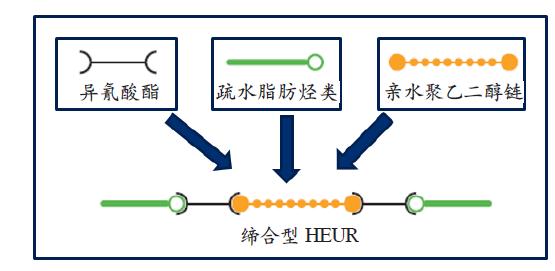
Figure 7 shows a schematic diagram of the composition of HEUR molecules, characterized by a “oleophilic hydrophilic oleophilic” triblock polymer with hydrophobic fatty alkyl groups at both ends and hydrophilic polyethylene glycol chains in the middle, which are extended by isocyanates. HEUR thickens aqueous systems by associating its hydrophobic end with the hydrophobic structure of latex particles, pigments, and surfactants to form a three-dimensional network structure. In addition, hydrophilic chains can also interact with water molecules through hydrogen bonding to produce thickening effects.
Therefore, when HEUR molecules have strong hydrophobicity, they exhibit pseudoplastic characteristics, significantly increasing medium and low shear viscosity while increasing high shear viscosity. When hydrophobicity is weak, it exhibits Newtonian characteristics and mainly contributes to high shear viscosity.
The binding of HEUR molecules with latex particles under high shear force increases the apparent viscosity of the aqueous system, resulting in a fuller coating. After the shear force decreases, the three-dimensional network structure of the system recovers, giving the coating good leveling properties.
Due to the low molecular weight of HEUR, the coating is also less prone to splashing during construction. When combined with latex particles, it does not produce volume limiting flocculation and has a high glossiness. But the intermolecular entanglement in the aqueous phase is limited, so the thickening effect on the aqueous phase is insufficient, and the anti sagging cannot meet the requirements.
In addition, HEUR is also sensitive to dispersants. When HEUR is used in combination with high acid content dispersants or small molecule dispersants, the stronger hydration effect of the dispersants causes water to bind with these ions and detach from the ethylene oxide skeleton, resulting in a decrease in the compatibility of HEUR with the system and a weakening of the binding effect. Therefore, HEUR should be used in combination with low acid content polymeric acid dispersants.
In summary, given the complexity of water-based coating formulations, a single type of rheological additive often cannot meet their rheological performance requirements. Therefore, the synergistic application of rheological additives will complement each other’s advantages and improve the production, storage, and application performance of water-based coatings.
3 Conclusion
The dual guidance of national consciousness and policy development is promoting the rapid development of water-based coatings. With the continuous extension of the application system of water-based coatings, as an indispensable component of water-based coatings, rheological agents have also shown diversified development. It is extremely important to select appropriate rheological additives to endow coatings with specific rheological properties for different application scenarios. In the future, environmentally friendly and functional rheological additives will be more favored.
Post time: Aug-19-2026